

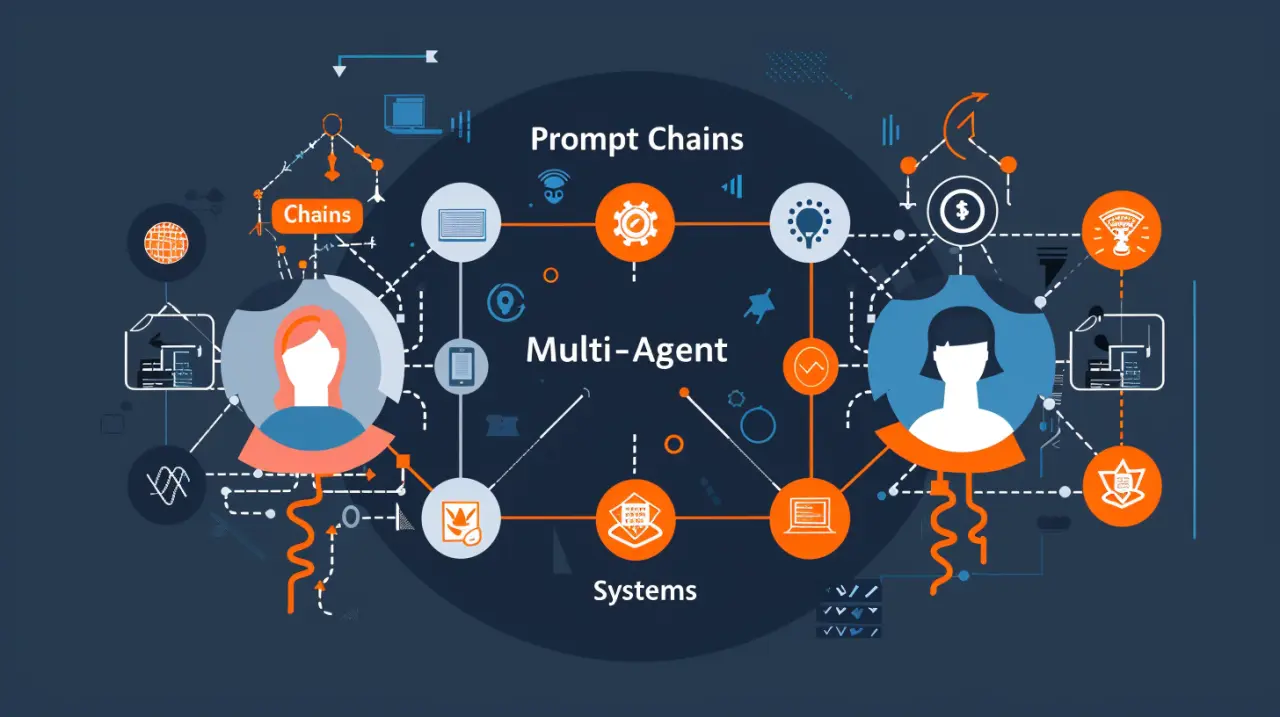
When people first encounter the concept of agentic AI, they typically imagine a single AI agent working through a task from start to finish. That mental model works for simple use cases, but the most powerful enterprise AI deployments look quite different. They involve multiple AI agents, each with specialized capabilities, each running its own decision loop, collaborating to tackle problems that no single agent could handle effectively alone. Understanding multi-agent systems is key to understanding how the most ambitious enterprise AI transformations are actually being built today.
Why Single Agents Have Limits
A single agentic AI system, no matter how capable, runs into practical limits when tasks become sufficiently complex. There is only so much context a single agent can hold at once. There is only so much parallelism a single agent can achieve. And when a task requires genuinely different types of expertise applied simultaneously, forcing everything through one agent creates bottlenecks and quality compromises that undermine the whole point of automation.
Think about how high-performing human teams work. You do not ask one person to simultaneously be the researcher, the analyst, the writer, the editor, and the project manager on a complex deliverable. You assign specialized roles to people who are good at them and coordinate their work toward a shared outcome. Multi-agent AI systems apply exactly that same logic to autonomous AI workflows, with coordination happening at the speed of software rather than the speed of human communication.
The Architecture of Multi-Agent Systems
Agentic AI solutions built on multi-agent architecture typically follow one of a few structural patterns. The most common is the orchestrator and specialist model. An orchestrator agent receives the high-level goal, breaks it into sub-tasks, assigns those sub-tasks to specialist agents with the right capabilities, monitors their progress, integrates their outputs, and delivers the final result. Each specialist agent focuses entirely on its specific domain without needing to know anything about the overall task structure.
Another common pattern is the peer-to-peer model, where agents communicate directly with each other without a central orchestrator. This works well for tasks that require iterative refinement, where one agent produces an output that another agent critiques, revises, or builds on in a continuous loop until quality thresholds are met. A third pattern is the pipeline model, where agents are arranged in a sequence and the output of each becomes the input for the next, similar to an assembly line but with intelligent processing happening at every stage.
Specialization Creates Dramatic Quality Improvements
One of the most significant advantages of multi-agent systems over single-agent approaches is the quality improvement that comes from genuine specialization. When an agent is designed specifically for one type of task, with carefully chosen tools, a targeted system prompt, and evaluation criteria tuned for that domain, it performs dramatically better than a generalist agent trying to handle everything.
Agentic AI data solutions built on multi-agent architectures commonly deploy separate agents for data retrieval, data validation, data analysis, and report generation, each optimized for its specific role. The data retrieval agent focuses on finding the most relevant and reliable sources. The validation agent checks for consistency and accuracy. The analysis agent applies domain-specific reasoning to draw insights. The report agent translates those insights into clear human-readable output. The combined result consistently outperforms what any single generalist agent can produce.
Research published by Stanford’s AI Lab in 2025 found that multi-agent systems outperformed single-agent systems on complex enterprise tasks by an average of 47% on quality metrics and 38% on completion rate for tasks that exceeded a defined complexity threshold. Those are not marginal differences. They reflect a fundamental architectural advantage that scales with task complexity.
Parallelism and Speed
Beyond quality, multi-agent systems offer a speed advantage that becomes increasingly significant as task complexity grows. A single agent must handle every step sequentially. A multi-agent system can run multiple steps in parallel, with different agents working on different aspects of a problem simultaneously and their outputs converging at the end.
Agentic AI solutions for enterprises dealing with time-sensitive operations particularly benefit from this parallelism. A financial institution conducting due diligence on a potential acquisition, for example, might deploy simultaneously running agents to analyze financial statements, research regulatory history, assess market position, and evaluate management team backgrounds, with all four streams running in parallel rather than sequentially. What might take a single agent hours to work through sequentially can be compressed into a fraction of that time with well-designed parallel execution.
Coordination and Communication Between Agents
Making multiple agents work together effectively requires thoughtful design of how they communicate and coordinate. Poorly designed multi-agent systems can actually perform worse than single agents because coordination overhead and miscommunication between agents introduces errors and inefficiencies that cancel out the theoretical benefits.
The most effective multi-agent systems use structured communication protocols that define exactly what information passes between agents and in what format. They include explicit handoff checkpoints where one agent confirms it has completed its contribution before another agent proceeds. They build in validation steps that catch errors introduced by one agent before those errors propagate through the rest of the system. And they maintain a shared memory layer that all agents can read from and write to, ensuring everyone is working from the same ground truth throughout the process.
Real Enterprise Applications
In legal services, multi-agent systems are being deployed for contract analysis workflows that would overwhelm a single agent. One agent extracts key clauses, another identifies potential risks against a library of precedents, a third checks regulatory compliance requirements, and a fourth synthesizes the findings into an executive summary with recommended actions. Law firms using this approach report that contract review time dropped by 71% while coverage and accuracy improved significantly.
In pharmaceutical research, multi-agent systems coordinate literature review, compound analysis, clinical trial data processing, and regulatory requirement checking simultaneously. A drug development team at a major U.S. pharmaceutical company reported that their multi-agent research assistant compressed the initial research phase of new compound evaluation from six weeks to four days.
In enterprise content operations, multi-agent systems handle research, drafting, fact-checking, editing, and agentic AI for localization across multiple target markets simultaneously, enabling content teams to produce and adapt content at a scale that was previously impossible without proportionally large teams.
Risk Management in Multi-Agent Systems
Multi-agent systems introduce some risk management considerations that are worth taking seriously. When multiple agents are taking actions autonomously, the potential for cascading errors increases. An incorrect output from one agent can become the input for another, amplifying the mistake rather than catching it. Designing robust error detection and correction mechanisms at every handoff point is not optional in production multi-agent systems.
Access controls are also more complex in multi-agent environments. Different agents may need different levels of access to different systems, and managing those permissions carefully prevents a situation where one misbehaving agent can take actions across your entire technology stack. Principle of least privilege, giving each agent only the access it needs for its specific role, is the right framework to apply.
Getting Started With Multi-Agent Architecture
If you are considering a multi-agent approach for your enterprise AI deployment, the most common mistake to avoid is jumping to multi-agent complexity before it is genuinely warranted. Start with a single well-designed agent and only move to multi-agent architecture when you hit clear limits that specialization and parallelism would specifically address.
When you do move to multi-agent design, map your workflow to identify natural specialization boundaries before choosing your framework. The role boundaries should reflect genuine differences in the type of reasoning, tools, and knowledge required, not just arbitrary divisions of a sequential process. Teams that design their agent roles around genuine functional differences consistently report better outcomes than those that divide tasks arbitrarily.
The Competitive Advantage of Getting This Right
Organizations that master multi-agent architecture are building a genuinely difficult-to-replicate competitive advantage. The combination of specialization, parallelism, and intelligent coordination creates system capabilities that far exceed what any individual AI tool or single-agent deployment can achieve. As enterprise tasks grow in complexity and the volume of AI-assisted work increases, the gap between organizations with mature multi-agent systems and those without will only widen.
Conclusion
Multi-agent systems represent the next level of enterprise AI capability, and understanding them is essential for any organization that wants to push beyond the limits of what single-agent deployments can achieve. The architectural principles are not complicated, but applying them well requires thoughtful design, careful coordination logic, and a genuine commitment to building systems that are reliable in production. The enterprises investing in this capability today are not just solving today’s problems more efficiently. They are building the infrastructure for a level of autonomous operation that will define competitive advantage for years to come.
