

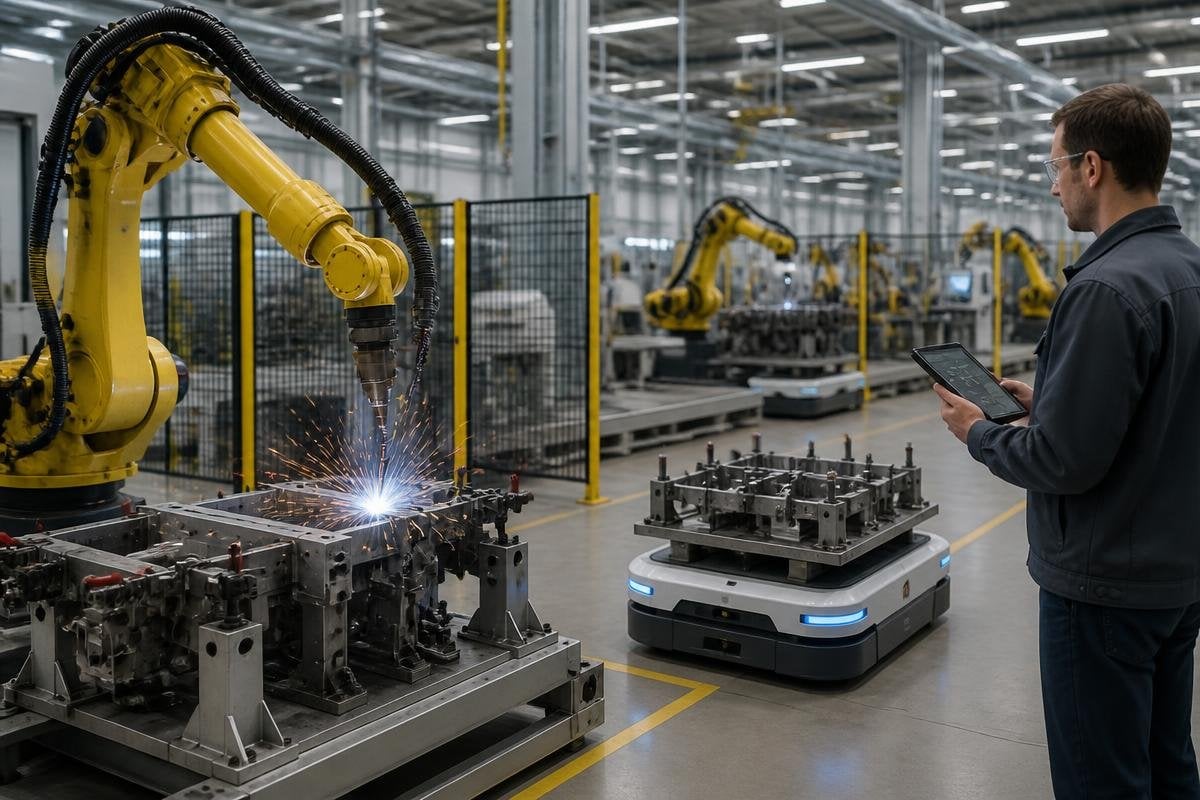
A factory robot can weld the same joint for hours, move parts between stations, or carry inspection cameras through a production line. The change matters because modern factories need steady output, repeatable quality, and safer ways to handle work that strains people.
- Robot arms repeat precise motions across long shifts
- Mobile robots move parts between work areas
- Sensors and software connect machines to factory data
Robot arms take on repeat work
Industrial robot arms remain the most familiar factory system. A six-axis arm can move a tool through several angles, so one unit may weld, paint, screw, or load parts when fitted with the right end effector. An end effector is the tool fixed to the arm.
That tool decides much of the robot’s job. A gripper picks up a part. A welding torch joins metal.
A camera checks shape, position, or surface marks. The arm repeats its programmed path, which gives the factory a steady process for parts that must match one another.
The arm still needs the part in the right place. Fixtures hold each item at a known position, and sensors check whether the item arrived before the motion starts. This link between the robot, the fixture, and the sensor often matters more than the arm’s top speed.
Mobile robots connect the work areas
Automated guided vehicles follow marked paths, while autonomous mobile robots use sensors to choose a route around people and equipment. LiDAR, which measures distance with laser pulses, helps a mobile robot map nearby objects and avoid contact.
The factory gains more than a moving platform. A mobile robot can carry bins between storage and an assembly line, return empty containers, or move finished parts to inspection. That cuts the time people spend walking between stations and gives the production system a clearer flow of materials.
The route still depends on the building. Narrow aisles, temporary pallets, reflective surfaces, and changing work zones can slow a mobile robot or stop it for a safety check. A system that works in a clear test area may need new maps, signs, and traffic rules on the factory floor.
Software links robots to production
Robots work as part of a larger control system. A programmable logic controller, or PLC, manages machine actions such as motor starts, clamps, and safety stops. A manufacturing execution system, or MES, records what each line makes and when it makes it.
Robot software connects these layers. ROS 2 is one example used for robot control and communication, though factories also rely on vendor systems and PLC networks. The purpose is practical: the right robot should receive the right job, report a fault, and wait safely when another process is not ready.
That software record matters as much as the robot’s arm or wheels. Reports on factory automation can show how a site handles faults and handoffs, giving you a clearer way to judge whether one connected line can keep working when a process stops.
Data can also show where a line loses time. A sensor may record motor temperature, cycle time, or failed part checks. Maintenance staff can then inspect a machine before a small fault stops the whole line, provided the factory has clean data and a clear response plan.
People still run the system
Factory automation changes jobs rather than removing every human task. Technicians set up tooling, check safety circuits, repair faults, and adjust programs when a product changes. Operators may load materials, inspect parts, or manage work that changes too often for fixed automation.
Safety remains part of the design. Industrial robot cells use guards, interlocks, and emergency stops. Collaborative robots add force and speed limits so they can work near people in approved tasks, but the setup still needs a risk check and clear operating rules.
I’d judge a factory robot by the work it completes after installation, not by a smooth demonstration on an empty floor.
A practical factory check
Before choosing a robot system, check these points:
- Name the task: record the part, tool, cycle time, reach, and payload
- Map the space: mark aisles, people, fixtures, storage points, and emergency access
- Check the handoff: confirm how the robot receives parts and reports finished work
- Plan recovery: write the steps for a jam, sensor fault, power loss, or stopped line
- Measure the result: compare cycle time, rejected parts, walking time, and downtime
- Set the service plan: list spare parts, software access, training, and response times
The next useful factory robot will be the one that fits this map and this service plan. If the task, safety controls, and recovery steps cannot be written down, the factory has more planning to do before it buys the arm.
